Enterprise resource planning has been around for decades. The core promise has always been the same: connect your business processes, centralize your data, and make better decisions. Most ERP systems delivered on the first two. The third one stayed out of reach.
The reason is straightforward. Traditional ERP stores data and reports on it. It does not interpret it. It does not act on it. And it definitely does not tell you what is about to go wrong before it does. That gap between data and decision is where most ERP implementations quietly fail, and where Microsoft Dynamics 365 is now pulling ahead of the rest of the market.
The Real Problems ERP Users Live With Every Day
Before discussing what Dynamics 365 does differently, it is worth being specific about what legacy and non-AI ERP systems actually get wrong. These are not edge cases. They are daily realities for operations teams, finance controllers, and IT leads across industries.
Manual reconciliation that never ends. In most ERP environments, bank reconciliation is a scheduled task that finance teams dread. Transactions from multiple sources are imported, matched manually, and exceptions are resolved one by one. A mid-sized business with high transaction volume can spend three to five days on this every period close.
Demand forecasting that relies on static logic. Most ERPs offer reorder points. You set a threshold, the system triggers a purchase suggestion when stock drops below it. That works when demand is predictable and linear. Fashion retail, automotive parts, and FMCG distribution do not operate that way. Static reorder logic cannot account for seasonal acceleration, variant-level velocity differences, or supplier lead time variability.
Financial reporting that requires a data analyst to produce. Connecting transactional ERP data to a meaningful board-level report involves extract jobs, Power BI or Excel models that break when schemas change, and IT dependency for every refresh cycle.
Exception management that happens after the damage is done. Cost overruns, margin anomalies, duplicate purchase orders, and posting errors surface during the audit or the period close review. By that point, the period is locked and the financial impact is already recorded.
AI features that exist on paper but not in practice. Several ERP vendors have added AI modules to their product roadmaps in response to market pressure. In most cases, these additions are bolt-on analytics tools or chatbot interfaces sitting on top of the same underlying architecture.
How Dynamics 365 Is Leading the AI Race in the ERP Space
Microsoft did not add AI to Dynamics 365 as a product extension. Copilot is built into the data processing layer of the platform, which means it operates on live transactional data as it moves through the system rather than on exported snapshots.
The practical difference is significant. In Business Central, Copilot performs bank statement reconciliation by matching transactions against open ledger entries using pattern recognition across payment references, amounts, and counterparty history. Finance teams review exceptions rather than process every line manually. In Finance and Operations, Copilot analyzes procurement patterns across legal entities, flags vendor invoices that deviate from contracted rates, and surfaces intercompany settlement anomalies before they roll into the consolidated close.
Demand forecasting in Dynamics 365 operates on a machine learning model trained on the organization’s own transaction history. It accounts for seasonal trends, promotional uplifts, variant-level sales velocity, and supplier lead time variability simultaneously. The output is a purchase order recommendation that reflects actual forward demand, not a static threshold.
Copilot also generates narrative financial summaries on demand. A finance controller can ask for a gross margin analysis by product category for the current period and receive a structured response with variance commentary in seconds, without an analyst building the report manually.
The Power BI integration with Dynamics 365 is not a generic connector. It is a purpose-built semantic model that maps transactional data to reportable dimensions automatically. Financial dashboards refresh as transactions post, and Copilot can interpret dashboard data in natural language, flag underperforming metrics, and suggest areas that warrant closer review.
These are not demo features. They are production capabilities that ERP users across manufacturing, retail, distribution, and professional services are running today.
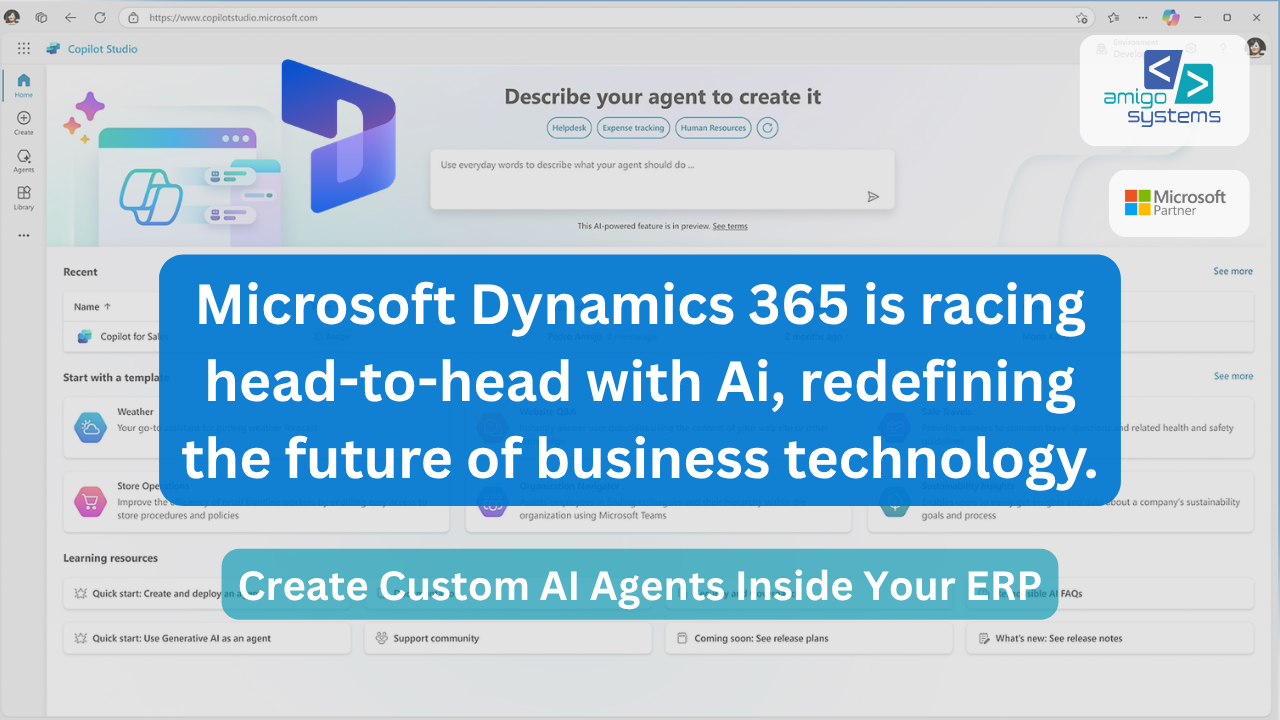
Create Custom AI Agents Inside Your ERP
With Dynamics 365, businesses can embed AI agents directly into their ERP workflows. Turning routine processes into intelligent, automated decisions.
For users, the benefits are immediate and tangible:
- Save hours by eliminating manual reconciliation.
- Forecast smarter with demand predictions that adapt to real trends.
- Get instant insights through natural‑language financial summaries.
- Catch problems early with real‑time anomaly detection.
Talk to Amigo Systems Before You Commit to Anything
Selecting and implementing an ERP platform is one of the highest-stakes technology decisions a business makes. The configuration choices made at the start of an implementation determine what the system can and cannot do for years afterward.
Amigo Systems is a certified Microsoft Partner with implementation experience across Business Central and Finance and Operations deployments in multiple industries. We assess your current operational structure, map it against the platform’s AI capabilities, and build a configuration that delivers measurable outcomes from day one.
Book a consultation with Amigo Systems before your next step.

"Amigo Systems is a certified Microsoft Partner with implementation experience across Business Central and Finance and Operations deployments in multiple industries. We assess your current operational structure, map it against the platform's AI capabilities, and build a configuration that delivers measurable outcomes from day one."





What do you think?
This strategic reallocation of resources can help companies create a significant competitive advantage.